

Santa Cristina, the heart of a community
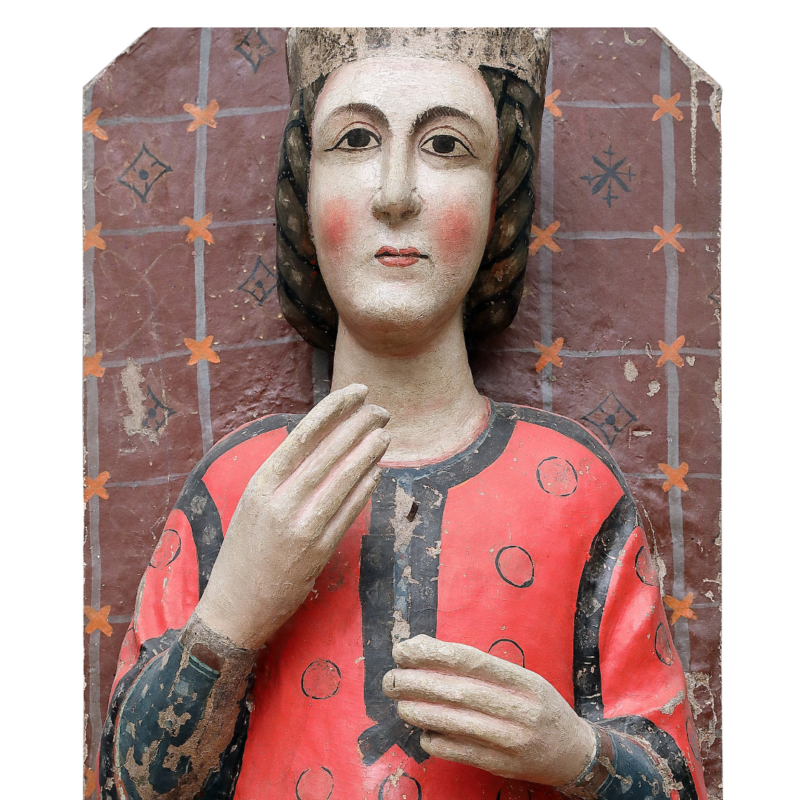
Some works of art tell a story. Others tell the story of an entire community.
The wooden statue of Saint Christina, carved around the mid-fourteenth century and now preserved at the Diocesan Museum and Basilica of Sant’Eufemia in Spoleto, is one of them. For museum visitors, it is a remarkable example of medieval Umbrian sculpture.
For the people of Caso, however, it is much more: it is the symbol of a community that has long recognized itself in its patron saint, whose presence has shaped the religious, social, and cultural life of the village for generations.
For this reason, the statue’s return to its original church is both an extraordinary and deeply meaningful occasion. Returning to the place for which it was created, the sculpture can once again be more than a masterpiece to admire: it becomes a living presence to pray to, invoke, and celebrate.
Saint Christina, High Upon the Hill…
For centuries, the women of Caso and the wider Valnerina turned to Saint Christina at the most important moments of their lives, especially when hoping to find a husband.
Today the saint is celebrated on 24 July, yet local tradition has always attached special importance to the feast of 10 May. On that day, unmarried young women would leave Sant’Anatolia and climb in procession to the church dedicated to Saint Christina, entrusting to her their hopes of finding a good husband.
Popular memory has preserved the prayer recited during this pilgrimage. With hopeful hearts—and their bridal chests already filled with carefully woven linens—the young women would say:
“Santa Cristina, Cristina mia, che stai tanto su,
famme trova’ marito sennò non ce vengo più.”
(Saint Christina, My Christina, high above,
help me find a husband or I won’t come back to visit you)
For this reason, Saint Christina became the protector of young women and future brides. Even today, her sanctuary is known throughout the Valnerina as the “Church of the Unmarried Women”, a lasting reminder of a popular devotion that remains deeply rooted in local memory.
Almond Trees, Little Apples, and Devotion
Saint Christina was not only invoked by young women. She was also called upon to protect the fertility of the land and ensure abundant harvests.
During the Rogation Days—ancient processions through fields and mountain paths to invoke divine blessing upon the crops—the community recited litanies that still bear witness to the close relationship between the people and their land:
“A fulgure et tempestate,
A flagello terremotus,
A peste, fame et bello,
libera nos, Domine.
Cristina su Capo le Campore,
fa’ vini’ bone le nostre mandole,
te rogamus andi nò.”
(Christina, on the hilltop above the fields, make our almonds good. Te rogamus, audi nos.)
According to local tradition, an elderly woman would always conclude the prayer by adding:
“E le mele roscette ‘ncò,
te rogamus andi nò.”
(And the little red apples too. Te rogamus, audi nos.)
Almond and apple trees were cultivated particularly in the area known as Piano delle Melette, whose very name recalls these small fruits.
These little red apples had a special value. Stored in straw, they would keep throughout the winter and provided an important food reserve. Even damaged fruit was never wasted: the sound portions were sliced, dried in the bread ovens after baking, and later chewed by women spinning hemp. The apples stimulated saliva, making the long and painstaking twisting of the fibres easier.
A Devotion That Has Endured Through the Centuries
The church of Saint Christina preserves numerous frescoes depicting scenes from the saint’s life and martyrdom, many painted as ex votos in thanksgiving for prayers answered. Together they testify to a devotion that has remained deeply rooted across the centuries, nourished by the faith of the people of Caso.
The origins of this cult may be remarkably ancient. Some scholars suggest that the veneration of Saint Christina reached the Valnerina between the fifth and sixth centuries through Syriac communities that settled in central Italy. Over time, the figure of Christina of Bolsena became intertwined with those of other saints bearing the same name, giving rise to a rich and layered tradition.
When the Emigrants Saved Their Saint
The importance of Saint Christina to the people of Caso is demonstrated not only by local traditions, but also by an extraordinary story that crossed the Atlantic Ocean.
In 1905, emigrants from Caso living in Trenton, New Jersey, organized a fundraising campaign to restore the statue of their patron saint. Within just a few months, they collected 120 dollars—a remarkable sum for men and women who had left the Valnerina in search of work and a better future.
Their generosity reveals more than any document could about the bond they maintained with their native village. Although living thousands of kilometres away, they felt compelled to preserve the symbol that most powerfully represented their shared identity.
Even today, the list of donors is deeply moving. Many of the surnames recorded in the subscription still belong to families living in Caso or to descendants who continue to cherish their roots there. More than a century later, those names still tell a story of belonging, memory, and identity. They remind us that the statue of Saint Christina is far more than a precious medieval sculpture: it is the thread that binds a community together, linking past and present, those who stayed and those who left, and connecting the people of Caso with emigrants who, even across the ocean, never ceased to consider her part of their own story.
On 24 July 2026, for the first time in many years, the statue of Saint Christina returns for a single day to the church for which it was originally created. It is more than the homecoming of a work of art: it is the return of a symbol that has accompanied the religious, social, and cultural life of Caso for centuries, restoring to the community one of the deepest expressions of its shared identity.
Il 24 luglio 2026 la statua di Santa Cristina torna, per un giorno, nel luogo per il quale era stata realizzata, restituendo alla comunità di Caso un simbolo identitario così importante da accompagnare per secoli la vita religiosa, sociale e culturale di un intero paese.