

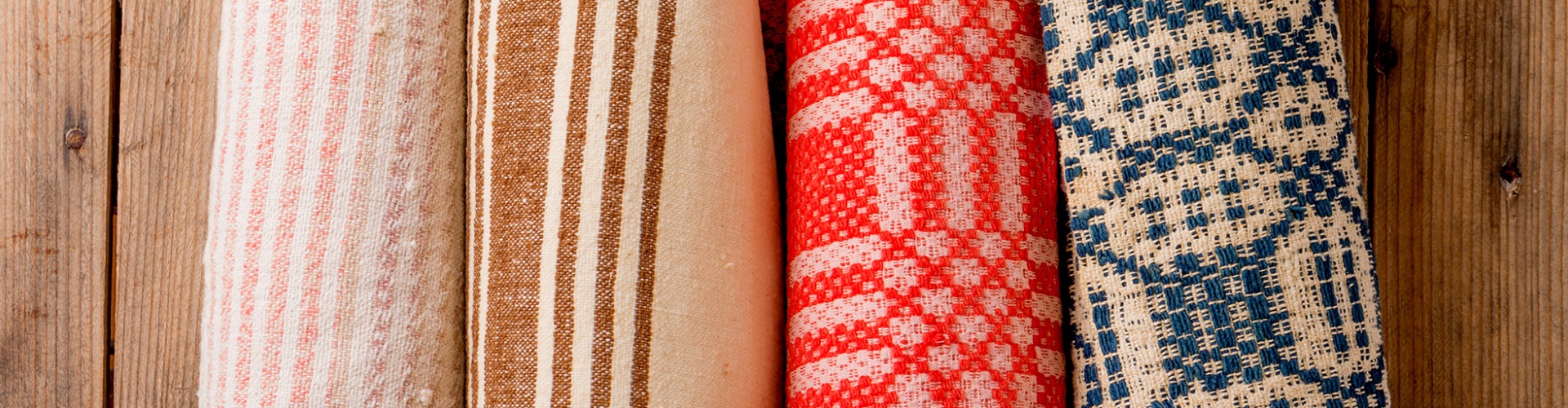
The objects, which make up the archive of the memories stored at the museum, have been donated by those who recognize the roots of their identity in the museum. As Angelo Rosati points out: “We have been collaborating together in the community, most of the stuff we have collected has been provided by families, especially traditional woven fabric. They were our trousseaus, part of our lives”.
The Museum’s archives and documentation fund include around 800 fashion magazines and a rich book collection on hemp and textile fibres.
Magazines in particular illustrate male and female fashion evolution, childhoods clothing, society and art evolution in Italy between 1920 and 1970.
The Museum preserves and exhibits a collection of 500 works in hemp and natural fibres, which covers the periods included between the mid-19th century and the 20th century.
The collection consists mainly of female and domestic textile artefacts. Through their different typologies and functions these woven fabrics deal with the phases of women’s daily life, from childhood to trousseau and beyond.
The founding nucleus of the Museum, composed of tools linked to the textile cycle and transformation of textile fibres, begins to develop from the 1970s.
Brakes, spindles, distaffs, reels, and old looms had been collected by Sandro Sabatini, Gregorio Amadio, Luciano Giacchè, to name but a few, in order to remember a material heritage and a textile tradition related to the territory.
The Museum has received valuable donations of sewing machines that tell stories of everyday life and women’s work, particularly from Sant’Anatolia di Narco, the Valnerina area, and Umbria.
Among these, the Consalvo Cardarelli Collection stands out. Donated in 2019, it comprises 116 sewing machines dating from the mid-19th to the 20th century. The machines are currently being restored thanks to the Art Bonus project “Adopt a Machine” and will be enhanced with a view to their future museum display.


