

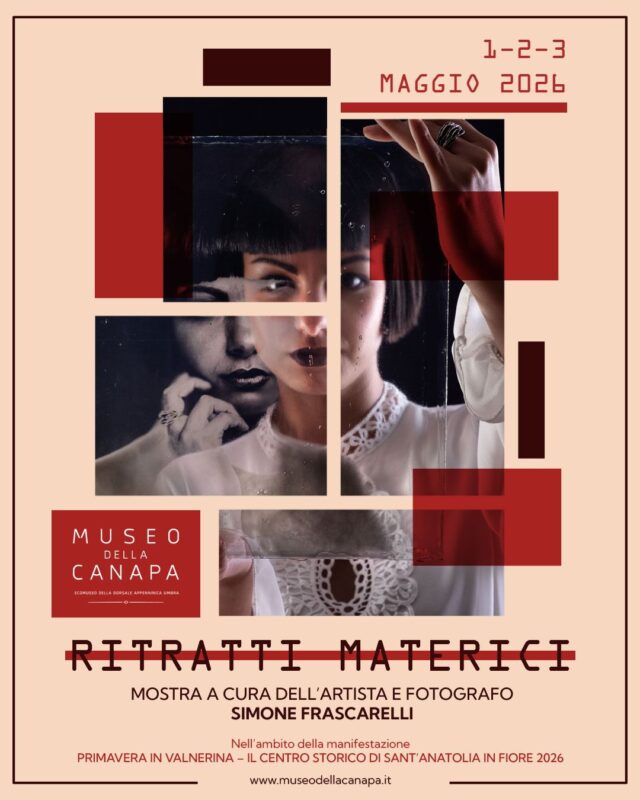
Five presences float in the darkness. Silver faces suspended in the void, held by glass like apparitions poised between what is and what appears. This is the immersive experience proposed by Ritratti Materici – Material Portraits, a project by Umbrian artist and photographer Simone Frascarelli, which will be inaugurated as part of the Primavera in Valnerina event and hosted within the Museum of Hemp.
The exhibition unfolds in a completely darkened room, where five beams of light, isolated in space, reveal the works while everything else disappears. In this rarefied environment, each portrait emerges as a suspended presence, devoid of background, capable of surfacing between the visible and the tangible.
The works originate from an ancient and fascinating photographic process: the wet collodion technique, introduced in 1851. In this method, each plate is exposed to light only once, and what appears white is neither ink nor print, but real metallic silver deposited on glass.
The reproduced image is physically embodied in matter. From the portrayed faces, materials emerge that seem to arise from within the body itself. These are not mere decorative elements, but extensions that make visible inner states, tensions, and necessities. Matter thus becomes language, action, transformation. What normally remains invisible takes form, at times in a disquieting way.
This tension extends to the wooden frames, where the same materials create a continuity between body, image, and object. The portrait is not simply contained, but expands into space, becoming a concrete presence.
The strength of the project lies in the thread connecting past and present: one of the most archaic photographic techniques generates strikingly contemporary images, where silver suspended in glass returns faces that, while entirely physical in fixing an identity, appear immaterial as they become a point of tension between body and matter, between what emerges and what remains hidden.
Thus, the exhibition Material Portraits becomes an invitation to observe not only what is seen, but what takes shape in the very process of observing the work itself.